

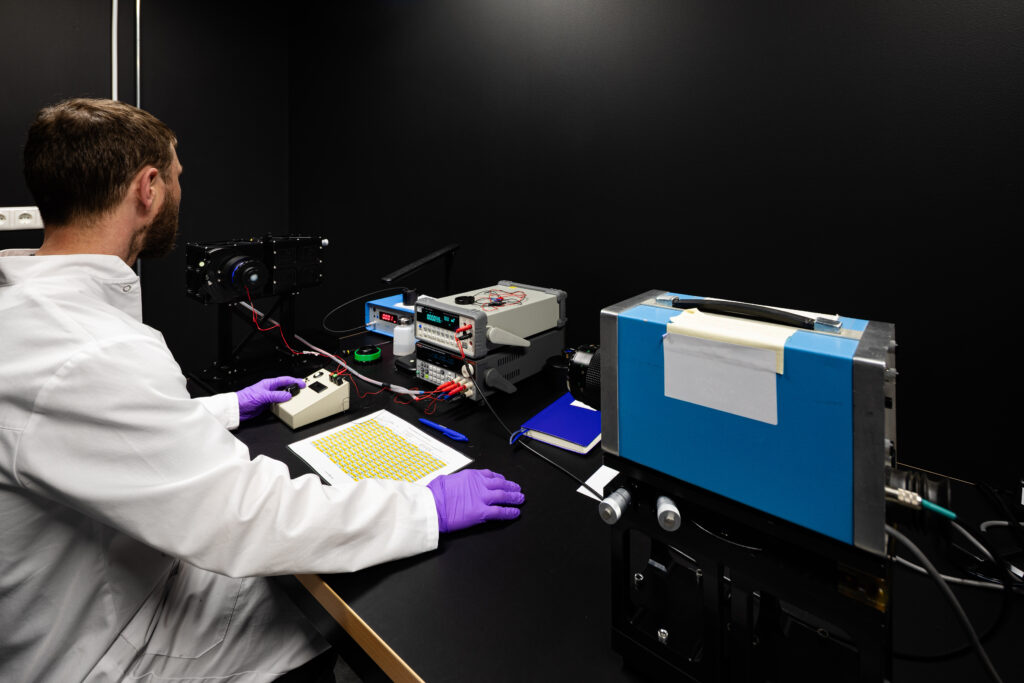
Environmental research increasingly relies on optical measurement techniques to evaluate complex physical and chemical systems. Before such methods are applied outside the laboratory, they must undergo controlled validation to confirm accuracy, stability, and reproducibility.
Laboratory-based research provides the conditions necessary to assess optical system behavior without external variability.
In applied research, laboratory environments serve as the foundation where experimental accuracy is established before real-world implementation.
Our work is focused not just on today’s agricultural needs, but on building long-term solutions that will serve future farmers, communities, and ecosystems. By harnessing science to create environmentally conscious crop systems, we’re helping ensure that the next generation inherits a planet rich in resources, resilience, and opportunity.
Controlled laboratory environments
Laboratory settings allow researchers to isolate variables that influence optical measurements, such as temperature, illumination stability, and material consistency. This level of control is essential for verifying system performance and identifying sources of measurement error.
Through repeatable experimental setups, optical methods can be refined and benchmarked against defined reference conditions.
Optical measurement and data interpretation
Applied optical research focuses not only on signal acquisition but also on the interpretation of collected data. Laboratory experiments support:
- validation of measurement repeatability
- assessment of system sensitivity and resolution
- evaluation of long-term signal stability
These factors determine whether an optical system is suitable for further development or deployment.
From experimental validation to applied research
By validating optical methods at the laboratory stage, research teams reduce uncertainty and improve the reliability of downstream applications. This process ensures that experimental results are grounded in measurable performance rather than theoretical assumptions.
Laboratory validation remains a critical step in transforming optical research into dependable analytical tools.