

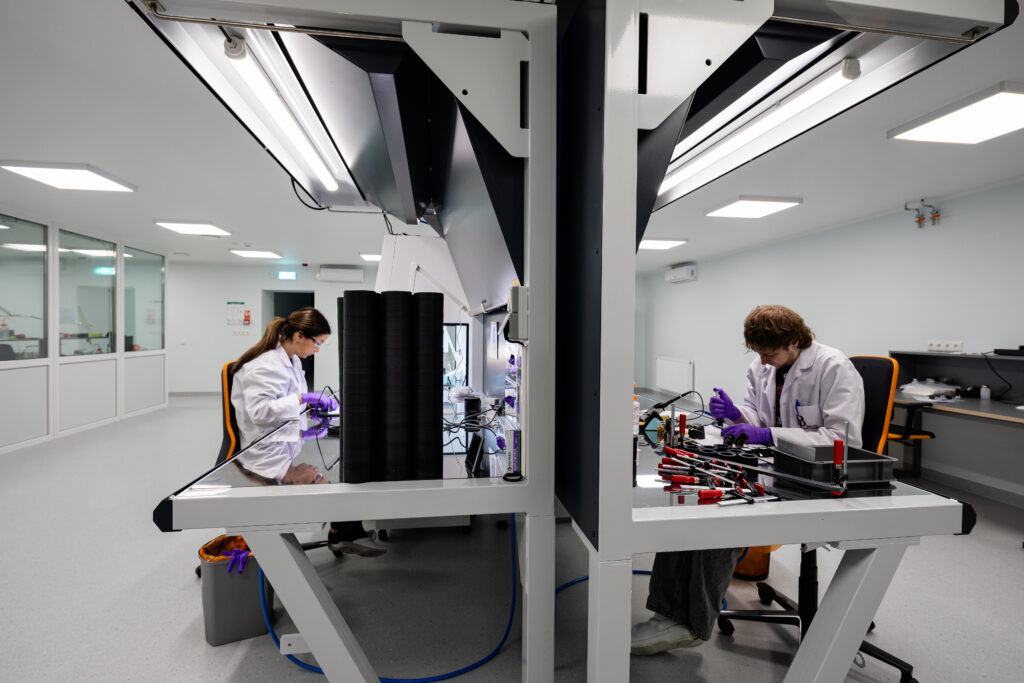
Environmental monitoring relies on accurate, reproducible measurement systems capable of detecting subtle changes in material and chemical composition. Laboratory-based optical research provides the controlled conditions required to validate these measurements before real-world deployment.
By working within calibrated laboratory environments, researchers ensure that optical data reflects true environmental signals rather than external variability.
Inside scientific laboratories, environmental research begins with a clearly defined question and a carefully designed experiment – transforming raw observations into validated data.
Laboratory settings enable precise control over experimental parameters such as illumination stability, sample preparation, and optical alignment. This allows researchers to isolate variables and evaluate system performance with high confidence.
Such conditions are essential for validating optical sensors used in environmental monitoring applications.
The role of laboratory environments in environmental research
Unlike field measurements, laboratory research enables precise control over:
-
- optical paths and illumination stability
-
- sample composition and preparation
-
- temperature, humidity, and environmental noise
-
-
calibration against reference standards
-
This controlled setting allows researchers to separate signal from environmental variability, ensuring that optical measurements reflect actual material or chemical properties rather than external interference.
Laboratory validation is essential for transforming optical sensing concepts into reliable environmental monitoring tools.
Optical and spectroscopic methods in environmental analysis
Laboratory-based environmental research commonly applies optical techniques including:
-
absorption and transmission spectroscopy
-
fluorescence-based analysis
-
wavelength-dependent material characterization
These methods support the detection of contaminants, concentration changes, and material properties with high sensitivity and repeatability.
Consistent research excellence
Effective environmental research depends on:
-
controlled optical experimentation
-
reproducible measurement workflows
-
engineering-driven validation processes
Through applied photonics and laboratory validation, environmental monitoring systems achieve the reliability required for scientific and practical use.